
A granite step outside a Georgian house on the south side and a poured concrete one outside a 1990s semi-d look broadly similar once they are clean, and they are not remotely the same job to get there. Dublin’s period housing stock carries materials the standard suburban driveway guide never touches, and each behaves differently under pressure.
Granite steps and kerbs
Granite is genuinely tough — far harder than any of the natural stone that turns up on a modern patio — and it takes real pressure without physical damage to the stone itself. What it does pick up over a century or more is a black, ingrained biological crust rather than a surface film, and that crust sits in the stone’s texture rather than on top of it, so it often needs more dwell time with a treatment than a younger surface of the same size would, even though the stone can easily take the pressure once it is time to rinse it off.
The genuine risk on granite steps is not the stone but the mortar or lime pointing between blocks where it has been relaid or repaired, which is almost always softer than the granite and erodes under sustained direct pressure well before the stone shows any wear at all.
Cobblelock and granite setts
Older granite setts — small square blocks rather than the rectangular concrete block paving covered in power washing driveways and patios — are usually bedded in sand exactly like modern block paving, so the joint-sand problem described there applies here too and matters more: original granite setts are harder to source and match than a modern paving block, so losing the bedding and having the setts shift or rock is a considerably more expensive mistake to put right.
Where a yard or laneway has been resurfaced with reclaimed or reproduction cobblelock rather than original setts, the material behaves like standard block paving and the same re-sanding rule applies without the higher stakes of working on the original stone.

Cast and wrought iron
Railings, boot scrapers and gates on Georgian and Victorian properties are usually painted cast or wrought iron, and the paint layer is doing real structural work — it is what is keeping the iron beneath from rusting. Pressure directed at flaking or blistered paint strips it faster than intended and exposes bare iron to weather immediately, which turns a cosmetic touch-up into a repainting job. Sound paint in good condition can be washed gently without concern; paint that is already failing is a job for scraping and repainting rather than cleaning, for the same reason a failing masonry paint finish is on a render wall.
Georgian brick and lime render
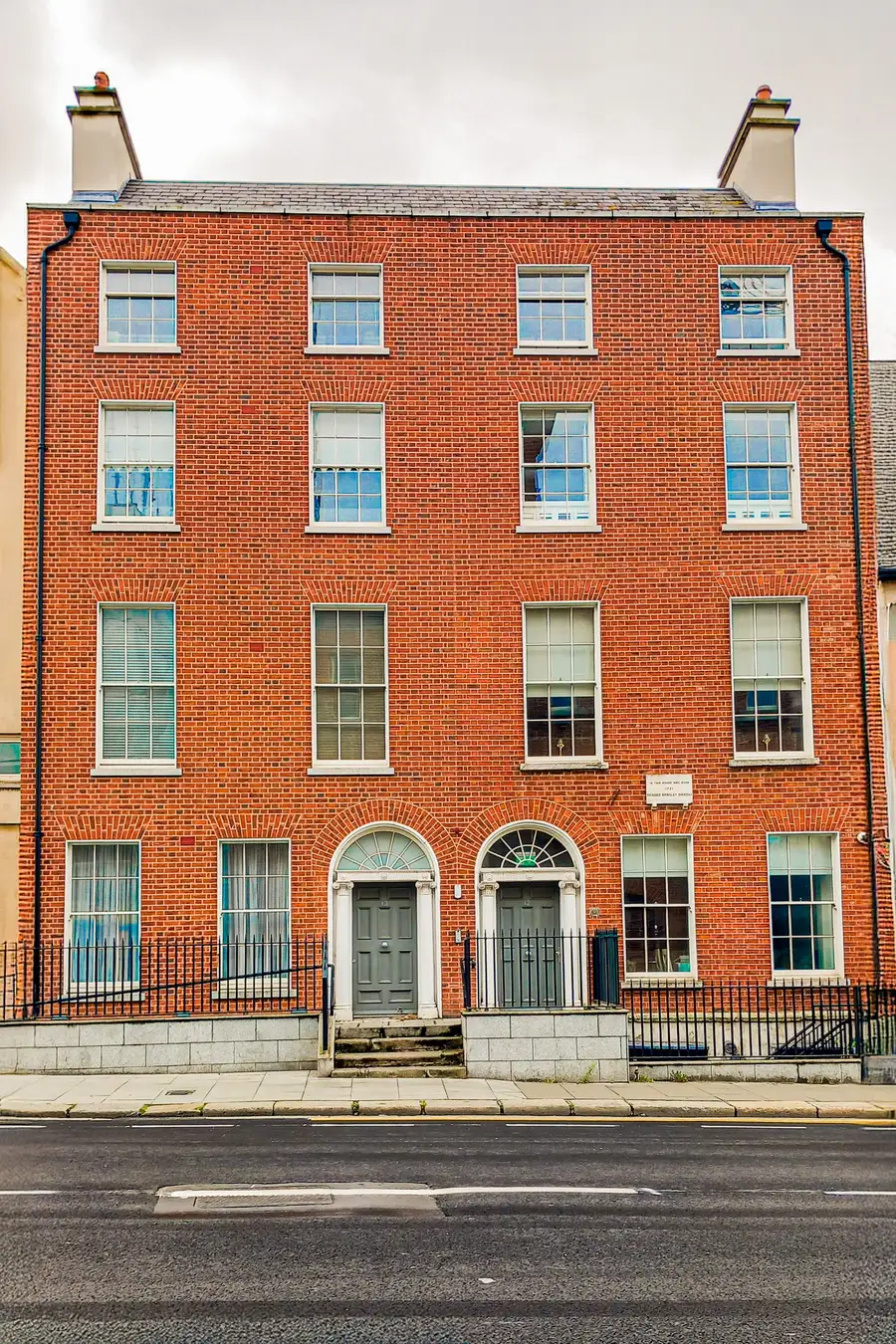
Dublin’s red-brick terraces and Georgian lime-rendered facades both need soft washing rather than pressure, for the same underlying reason K-Rend does — see render and house washing for the full method. The one thing specific to older brick and lime render: original lime mortar and lime render are considerably softer than modern cement-based equivalents, and pressure that a modern render would shrug off can erode lime pointing and lime render finishes permanently. A property with confirmed lime construction needs that flagged before work starts, not identified partway through the first elevation.
The one mistake common to all four
Treating a period property as a faster version of a modern one. The materials above all tolerate less aggressive cleaning than their modern equivalents, take longer to assess properly, and are considerably more expensive to get wrong — a damaged cast iron gate or an eroded lime-pointed step takes real skill and real time to put right, in a way a scuffed concrete slab does not. A quote for a period Dublin property that reads identically to a quote for a modern semi-d, using the same rates and the same assumptions, has usually not accounted for any of this.