
Ask what a roof is made of and most people say “tiles”. On a Dublin house that one word covers four different materials, each of which reacts to cleaning in a different way. The method that suits a 1980s semi in Lucan can crack the slates on a Victorian terrace in Rathmines. So before any question about cost or timing, it is worth knowing which roof you have.
Telling them apart from the footpath
You do not need a ladder for this. Stand across the road, ideally with the low sun behind you, and look at the bottom edge of the roof, just above the gutter, where the edges of the roof covering are easiest to see.
- Natural slate is thin. The edges are barely visible, the surface is flat and slightly uneven from one slate to the next, and the colour is usually a blue-grey or purple-grey with a faint variation across the roof. Small strips of lead or copper hooked under the bottom of individual slates are tingles, which are repairs holding slipped slates in place.
- Concrete tiles are thick. Seen from the side they have a chunky, rounded or squared edge, and many have a visible profile: a wave, two rolls per tile, or a flat face with a deep interlocking edge. Up close the surface is slightly gritty rather than smooth.
- Fibre-cement slates are the imitation of slate. They are as thin, but completely uniform: identical size, identical colour, perfectly straight edges. The giveaway is a small copper disc and rivet at the bottom centre of each slate, which holds the tail down and which natural slate does not have.
- Clay tiles are red, orange or brown, small, and slightly curved along their length. They are much less common in Dublin than across the water in England.
Natural slate: the period houses
Slate is what the Georgian, Victorian and Edwardian housing stock is roofed in: the terraces of Rathmines, Ranelagh, Phibsborough, Drumcondra and Stoneybatter, and the larger period houses of Rathgar and Monkstown. A great deal of it is Welsh slate, much of it on the roof for a century or more.
The slate itself is extremely durable and barely absorbs water, so it does not grow moss the way concrete does. What grows on it sits in the gaps between slates and along the overlaps, and lichen colonises the face slowly over decades. The vulnerability is elsewhere:
- It is brittle. A slate that has survived a hundred winters can still snap under a knee or a boot. Old slate roofs should not be walked on by anybody who does not have to.
- It depends on the overlap. Each slate is covered by the two courses above it, and that overlap is what keeps the rain out. A jet of water aimed up the slope goes straight into it.
- The nails go before the slate does. Older slates were fixed with iron nails that corrode, a problem roofers call nail sickness. If you can see a lot of tingles, or slates that have slid down out of line, the fixings are failing. Heavy scraping on a roof in that state will dislodge more.
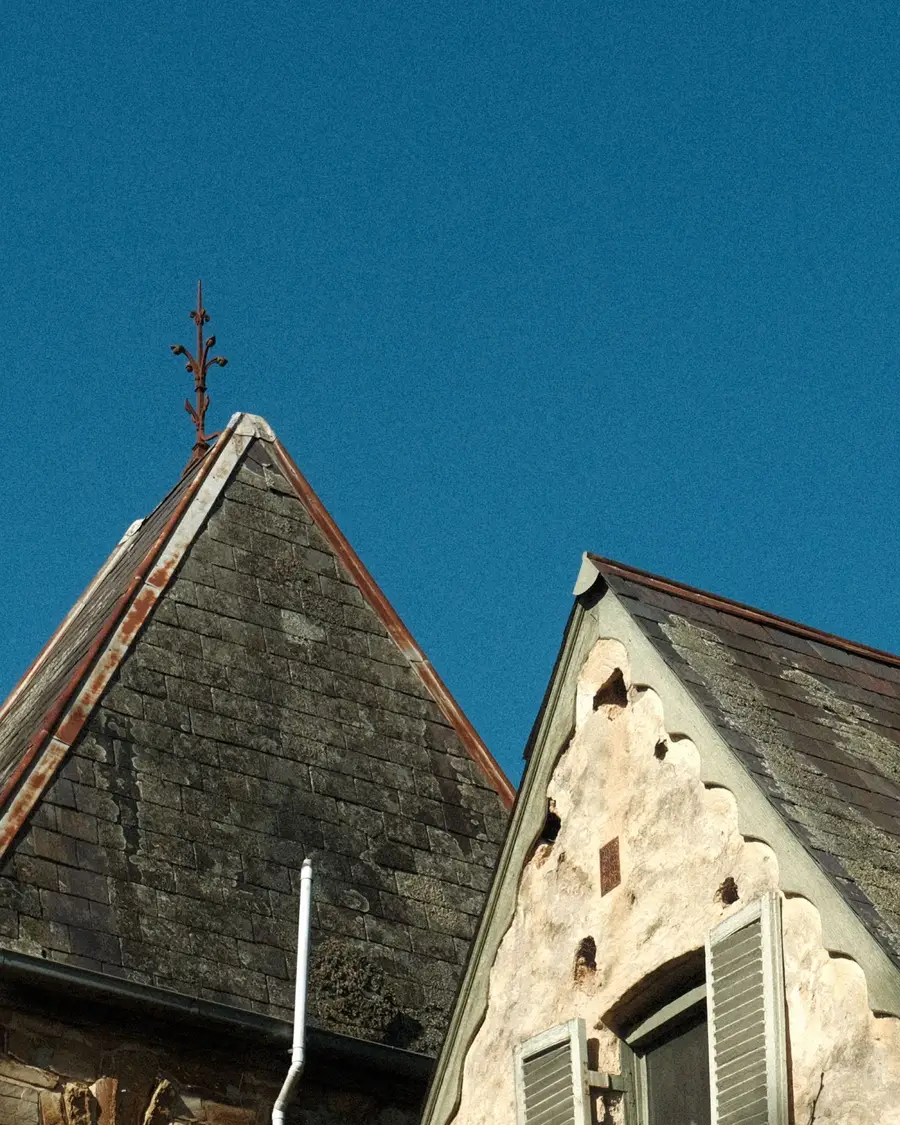
In practice, cleaning a slate roof means removing moss from the joints and gutters by hand and treating with a biocide at low pressure. It does not mean making every slate look new. Lichen on old slate is often best treated and left to weather off over time, because getting it off by force costs more in broken slates than it gains in appearance.
Concrete tiles: most of suburban Dublin
From the 1960s onwards, the estates that make up most of suburban Dublin, from Tallaght and Clondalkin to Swords, Lucan and Blanchardstown, were overwhelmingly roofed in concrete interlocking tiles. If your house was built in that period and has not been re-roofed in something else, this is almost certainly what you have.
Concrete tiles are tough in one way and fragile in another. The body of the tile is strong and heavy. The surface is the weak point: most concrete tiles leave the factory with a thin coloured or granular finish over a porous core. That finish is what sheds water and what gives the roof its colour, and it is the first casualty of a pressure washer. Strip it and the exposed concrete underneath soaks up water, holds spores, and goes green again faster than it did before the “clean”. This is the single most common way a roof is made worse by cleaning it, and it is why the soft-washing approach exists.
The rough surface is also why concrete grows more moss than slate does: there is more for it to hold on to. That is not a defect; it is how the material weathers. But it means a concrete-tiled roof facing north or shaded by trees will need attention on a shorter cycle than its neighbour on the sunny side of the street.
Fibre-cement slates, and the asbestos question
Fibre-cement slates became popular from the 1970s and 1980s as a cheaper, lighter alternative to natural slate, and they are common on Dublin houses and extensions from that period onwards. They are thin and brittle, and they do not take kindly to being walked on or scraped hard. Older ones often go soft and flaky at the edges as they weather, which is the point where cleaning them stops being worthwhile.
The more important issue is age. Asbestos was used in fibre-cement products for decades before it was banned, and the rule of thumb in the trade is that fibre-cement roofing installed before about 2000 may contain asbestos. That includes slates on the main roof, and very often the corrugated sheeting on older garages, sheds and lean-tos.
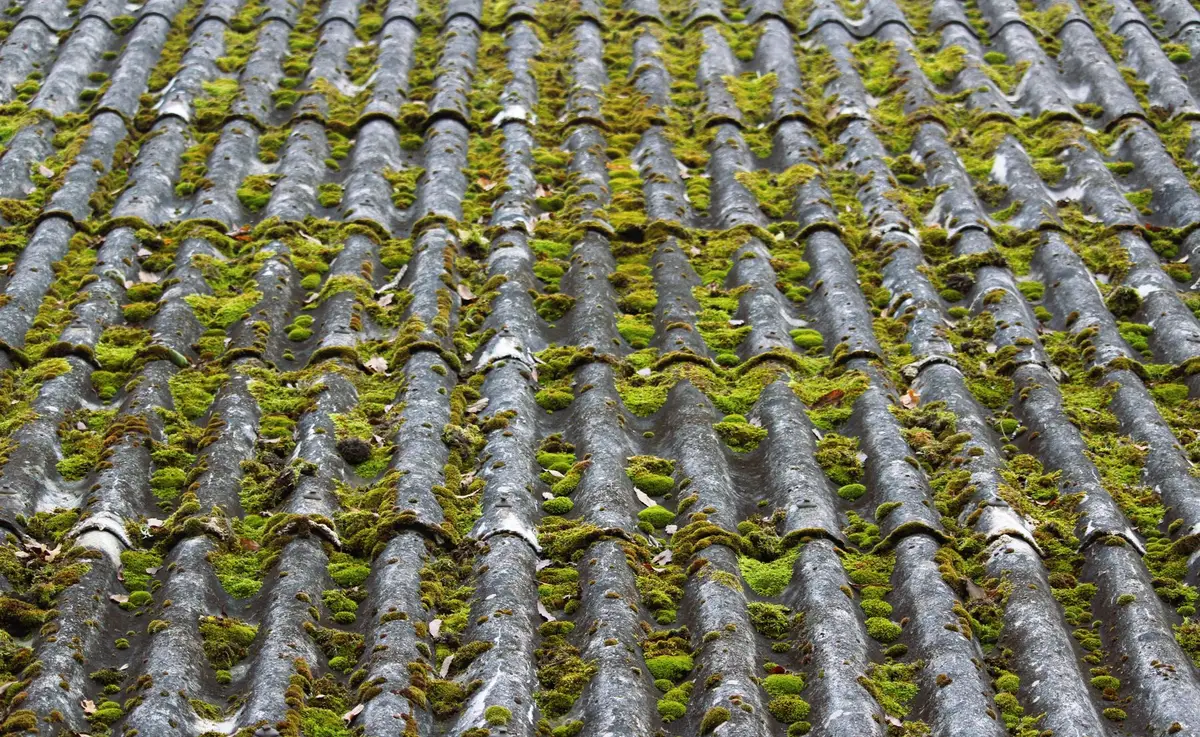
Asbestos cement that is intact and left alone is generally considered low risk. What releases fibres is abrading the surface, which is exactly what pressure washing, wire brushing and hard scraping do. So the practical rule is simple: if a fibre-cement roof or sheet might pre-date 2000 and nobody knows what it is made of, nobody should pressure wash, scrape or walk on it until a sample has been tested. If you have the original building paperwork, the product name may settle the question. If not, testing is inexpensive compared with dealing with contamination.
Clay tiles
Clay tiles turn up on some Edwardian and inter-war Dublin houses and on the occasional newer build chosen for the look. Fired clay is denser than concrete and holds its colour, but old clay tiles become brittle, and frost damage shows as flaking faces. They are cleaned the way slate is, gently and with the overlaps in mind, rather than the way concrete is.
What this means for a quote
The material decides three things about a roof clean: whether the roof can bear any weight at all, how hard the surface can be worked, and whether it should be cleaned at all. That is why a quote given over the phone without anyone having looked at the roof is a guess. A competent contractor should be able to tell you which material you have and how that changes the method. The rest of the process is set out in how roof cleaning works, and what moves the price is in what roof moss removal costs.